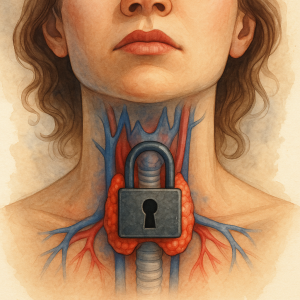
Your thyroid isn't the problem. Your throat has been trying to tell you something.
You've done the blood work. You're on the medication. You track your TSH like a part-time job. You've cut gluten, added selenium, tried the elimination diet, the supplements, the 6 AM walks.
Not dramatically terrible — nobody around you would know. You show up, you deliver, you hold everything together. But underneath the functioning, there is a fog that won't lift. A tiredness that sleep doesn't fix. A body that feels like it belongs to someone slightly older, slightly heavier, slightly less alive than you remember being.
Your doctor says your levels are controlled.
You know something is still wrong.
You are not imagining it. And you are not broken. But I want to suggest something that your doctor, through no fault of their own, has probably never had the time to offer you.
Your thyroid is not the origin of this story. It is where the story eventually arrived.
The thyroid and the throat
The thyroid gland sits in the throat. In the yogic tradition, the throat chakra — Vishuddha — governs expression, truth, and the voice. Whether or not you hold any belief in that framework, the anatomical fact remains: the thyroid and the throat are neighbours. And working with people living with thyroid conditions, what I have observed — consistently, without exception — is this.
The thyroid struggles in people who have a complicated relationship with their own voice.
Not their speaking voice. Their inner voice. The one that knows what they need, what they want, what they will not accept — and has learned, over years and sometimes decades, to stay quiet.
The person with Hashimoto's who has been the family peacekeeper since childhood. Who learned early that her anger made things worse, that her needs made people uncomfortable, that the smoothest path was the one where she asked for nothing and gave everything.
The woman who says yes at work because saying no feels like letting people down. Who carries her exhaustion privately because being seen as capable is the only kind of safety she has known. Who swallows disagreement in the same automatic way she takes her Eltroxin every morning — without thinking, without questioning, because this is simply what you do.
The throat, in these cases, is not just anatomy. It is the site of a very old negotiation. A negotiation between what is true and what is safe to say.
And the thyroid — sitting right there, in the middle of everything that has been swallowed — begins, over time, to reflect that negotiation in its function.
This is not your fault
I want to be very clear about something before we go further.
This is not about blame. You did not give yourself Hashimoto's by being too agreeable or too self-sacrificing. You are not being punished for people-pleasing. The patterns that led here were learned in environments where they made complete sense. Where softening yourself was genuinely safer than standing firm. Where being needed was more reliable than being seen.
These are not character flaws. They are adaptations. Intelligent, understandable, deeply human adaptations.
But the body does not distinguish between a pattern that was once necessary and one that has outlived its usefulness. It simply responds to what is currently running. And if what is currently running is twenty years of suppressed expression — of voice that never quite made it out of the throat — the thyroid will keep telling you about it.
Until the pattern changes, the conversation between you and your diagnosis will stay the same.
What the research says
Psychoneuroimmunology — the study of how the nervous system, immune system, and emotional life interact — has documented clearly that chronic emotional suppression creates chronic physiological stress. The HPA axis stays activated. Cortisol runs elevated. Inflammation becomes the default state of the body rather than a temporary response to threat.
For autoimmune thyroid conditions like Hashimoto's, this is particularly significant. Autoimmunity means the immune system is attacking the body's own tissue. The question worth sitting with — not as metaphor but as genuine inquiry — is what in your emotional life has taught you to turn against yourself? What conditions did you grow up in that made self-attack a learned response?
These are not comfortable questions. They are also not optional, if you want to address what is actually driving the condition.
What is possible
I am not asking you to stop your medication. I am not suggesting that emotional work alone will regulate your TSH. What I am suggesting is that the conversation your thyroid has been having with you — through fatigue, fog, hair fall, weight, and the particular sadness of feeling like a stranger in your own body — is a conversation worth joining.
When we work with the emotional roots of thyroid conditions in the SomaShadow Method, we work with:
The suppressed voice — the specific pattern of what you have been unable to say, and to whom, and for how long.
The nervous system — bringing the body out of chronic protection mode so that healing becomes physiologically possible.
Bach Flower Remedies — specific remedies for the emotional states that sit underneath thyroid dysfunction. Agrimony for the one who smiles through suffering. Centaury for the one who cannot refuse. Mimulus for the quiet fear that has no name. These are not vague; they are precise.
Shadow work — meeting the part of you that learned to make herself small, not with judgment but with the kind of honest compassion that allows something to finally shift.
None of this replaces medicine. All of it addresses what medicine doesn't reach.
A question to sit with
Think of the last time you said something you genuinely meant — not the diplomatic version, not the softened version, not the version edited for the comfort of the room.
How long ago was that?
If the answer makes you pause, your thyroid has been trying to tell you something. This is your invitation to listen.